

Get Your Next Post Idea Before Your Coffee Brews—10 (Stealthy) Ways in Under 3-Min.
It may feel like cheating (And no...it doesn't involve AI)


It feels like cheating, but it’s NOT. I promise. It’s 100% legit. —
Why lazy? Because it doesn’t involve squeezing your mind about what to write. Just looking in the right places, where the ideas are already there for the taking.
It’s a fact that deciding on the next post idea sometimes becomes a bigger task than actually writing it out. For times like that, you must count on these low-effort, high-yield ways to get your next idea.
1. From what you read.
Reading is subconscious writing. Because reading incites thoughts, and thoughts are a writer’s currency. So, what you read will always find its way to your words.
For example, I was reading this post on my Google feed a few days back:

The word ‘battle’ caught my attention, and I started thinking—what does a new writer battle with? This thought was the starting point of my last week’s post:

Start taking hints from your reading feed.
2. From YouTube.
Yes, the storehouse of ideas. Honestly, this one does feel really lazy to me. Okay, let’s shed the guilt and get to work. Say your niche is time management. You type ‘time management+tips+ideas.’
It will throw some relevant videos. Choose a relevant one and NO. You don’t have to watch the whole video. Here’s what you do: Go to the description and click ‘more.’ Like this:
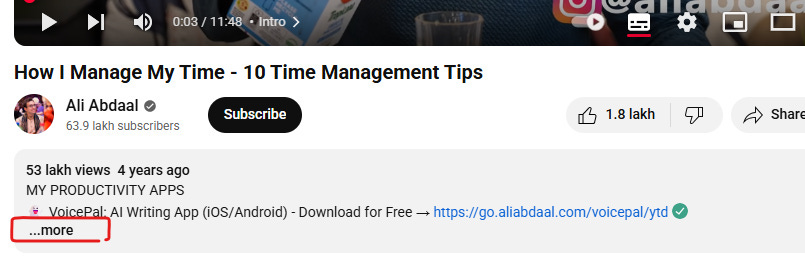
And there you MAY find (because some creators add this and some don’t) a timeline breakup of the topic, like this:
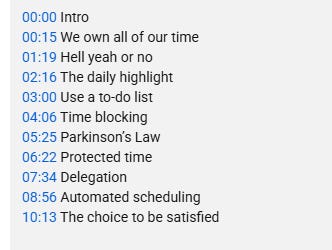
Bingo. You have your framework for the idea. You may click on a few other videos and hunt for more.
Why this doesn’t count as cheating?
Having a couple of pointers doesn’t get the post written all by itself. You still need to write it down. I know, you know, we all know that just the points don’t do it all; how you word them is the actual job. That’s the real job.
3. Amazon’s ‘look inside’ hack.
This is again very similar to the YouTube hack, but with a book-centric approach. Obviously, you can’t turn a whole book into a post, but we are looking for pointers/ideas, remember?
I am taking the same niche as above, time management. You go to the search bar and type—books+time management. You will get a list of books as usual. Now go for books that have a ‘read sample’ option. Look for the content table.
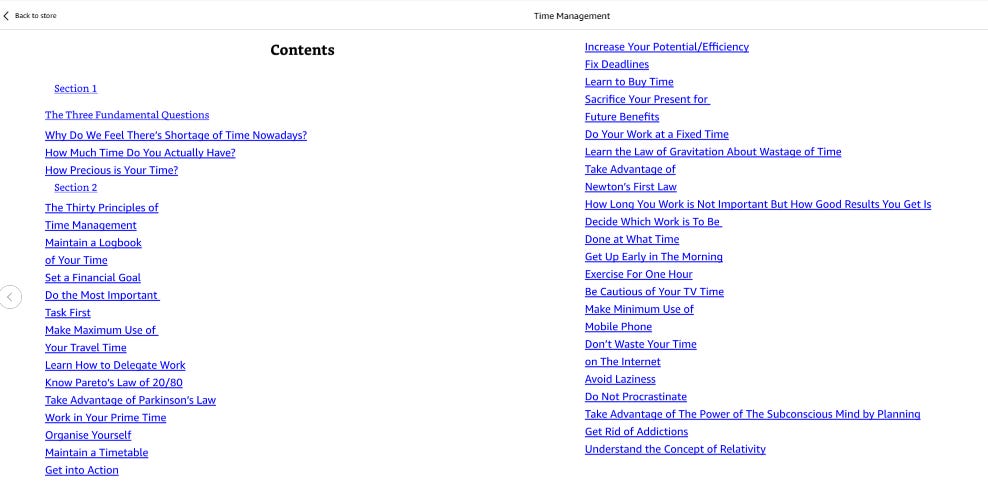
Like earlier, you don’t have to read the whole book. Just flesh out the pointers.
4. Answer what people are (already) asking.
They say write for your readers, solve their problems. Well, these are the hubs where your audience comes with their problems—Quora & Reddit.
I write for new writers. Say, I want to find some time-related problems of writers. So, I go to Quora and type ‘new writers+time+challenges.’
And these are some of the interesting questions people are asking:
“Why can't I finish anything I start? I always lose interest or give up because it takes too long to finish.”
“What should every aspiring writer know about balancing writing and life?”
“Can you suggest the best tools that help a writer to write more?”
No second-guessing the problems. Straight from the horse’s mouth.
Someone out there is asking the question.
All you have to do is answer with your voice and your inputs—instant relevance.
5. What other writers are talking about?
Your nice contemporaries. What are they ruminating on? Join the chatroom. No, you don’t need to eavesdrop on every bit and vomit it out. Borrow the idea.
Before you start frowning with the ethical question marks, let me tell you two things:
Over 90% of the content you see is not original. No one invents ideas out of the blue.
They borrow the idea and own the story.
Regardless of the topic, you will always have something unique to share. People are looking for that ‘you-element.’
Don't tell me you were struck with your writing idea after reading another writer’s blog post. Yes? Great? Let other people pump you into writing more.
6. Your high-engagement Tweet/Note.
We all feed the algorithm constantly to up our writing game—nuggets for the mind.
And sometimes, they click. Keep gathering momentum. People seem to latch on to the thought. A resonance. That’s when you know you have found a nerve, a good one.
Don’t waste it. That’s the foundation on which you must build your next story.
7. Your comments are bonsai-ideas.
Why are comments a great idea generator? That’s because a comment is a conversation initiated by another individual in your niche. So, on the spur of the moment, your mind may come up with a beautiful streak worth exploring more. There, you must be ready to catch them.
This was my response to a reader’s comment:
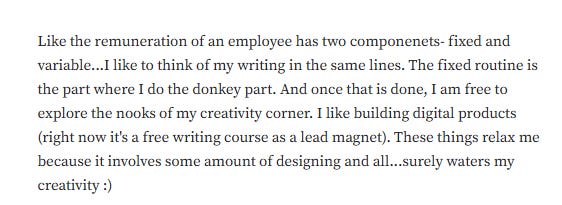
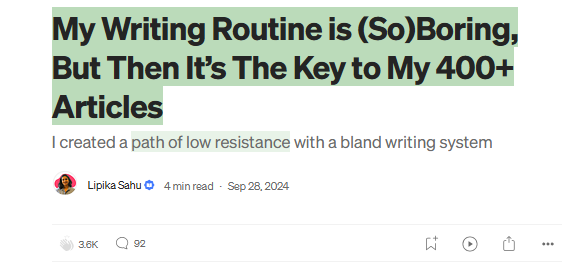
And that went on to become a viral story on Medium:
Remember to jot down the idea if you don’t plan to write it right away.
8. Your old stash of half-baked ideas.
Every writer will have this—a bank of unfinished writings. If incomplete drafts could fetch us money, all writers would be rich. Anyways, it’s a great place to look for ideas to write about.
Why this one works:
You have already done half the job, in fact, more. Starting from there is less mental load.
Revisiting the idea after a gap may bring fresh insights and angles that you might have missed the first time around.
I say this because I often rely on this hack when I am time-crunched. And this has worked every time.
9. Grab one pointer from a big listicle.
1 listicle of 10 ideas = a summary of 10 posts.
Each idea in a listicle holds the potential to become a post. So, this is how you do it right:
Pick a listicle that has resonated well with your audience.
Pick one idea from the list that you feel you can explore more, or go deeper.
Simple and smart. And it’s refreshing, if you ask me. Because many times I feel restricted when elaborating a point, in fear of overstretching the reading time. But with this, I get to say all that I have to say.
10. Behind-the-scenes stuff.
People love peeping. We are eternally nosy. That’s just us, humans. So, share:
things that you are building, or
how you accomplished something, or
hacks that are working for you, or
your work rituals.
Need not be extensive things. Just mini-chapters from your desk for your readers to know.
Why it works:
It makes you (& your content) more human.
It builds trust by showing your work ethic.
It often sparks conversations—people relate to struggles.
The final thought…
My experience is that after a certain point in writing, more than the writing part, the idea part becomes more challenging.
What to offer your readers becomes more difficult than how to offer.
So, having some go-to places to look for that next idea is a smart move to have. Let me know which one of them you used for your next post?
420+ people have benefited from this 6-day email course—Write With Flair.
Practical examples and actionable tips—this course will fix a big chunk of your writing struggles, one email at a time.
Kickstart your writing from here:
Get your free 30-day writing journal with prompts to help you develop a writing habit.
This Headline Power Booster is an updatable Excel sheet featuring over 700+ power words to choose from, helping you boost your headline power.